
Posted by Keith J - Tactical Solutions on 15th Jul 2026
Night Fighting Has Changed: Is Your Force Ready?
For decades, darkness provided soldiers with a tactical advantage. Those equipped with night vision could manoeuvre, observe and engage while remaining largely unseen.
That advantage no longer exists.
Today's battlefield has fundamentally changed. Thermal imaging, infrared sensors, unmanned aerial systems, laser aiming devices and digital targeting technologies are now widely available, giving both state and non-state actors unprecedented capability to operate after dark. As highlighted in GSCI Advanced Photonics' recent white paper, Night Fighting & Soldier Modernization: Reducing Operational Risk Through Integrated Electro-Optical Systems, night has become a contested domain where technological superiority often determines mission success.
Winning the Night Requires More Than Night Vision
Many military modernisation programs continue to focus on procuring individual pieces of equipment, thermal weapon sights, night vision goggles, laser aiming devices and infrared illuminators.
While each system may perform exceptionally well in isolation, the operational advantage comes from how effectively they work together.
Integrated electro-optical systems enable soldiers to detect threats faster, positively identify targets, engage with greater precision and maintain superior situational awareness under the most demanding operational conditions. Rather than carrying multiple standalone devices, today's soldiers require a connected capability that simplifies operations rather than adding complexity.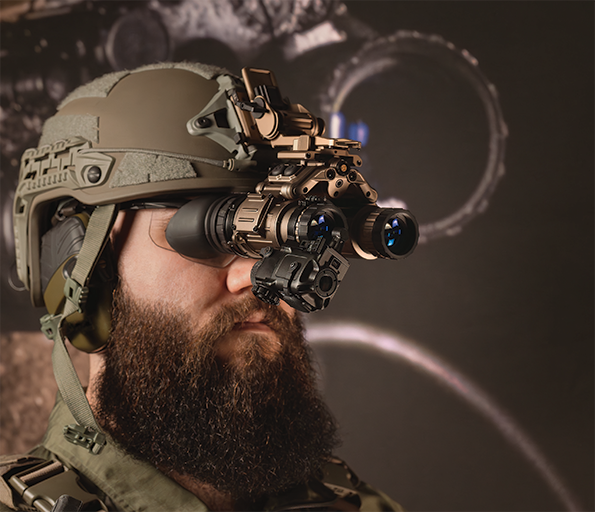
The Hidden Risks of Equipment Fragmentation
Many defence forces have acquired equipment over decades from multiple manufacturers. Although each component may meet individual performance requirements, interoperability between systems is often overlooked.
The result can include:
- Increased training requirements.
- Greater maintenance complexity.
- Higher weight and power consumption.
- Reduced interoperability between critical systems.
These challenges not only increase logistics burdens but also place greater cognitive demands on operators during high-stress missions.
Modern Soldiers Need Simplicity, Not Complexity
Today's soldiers process more information than ever before.
Communications, navigation, thermal imagery, laser aiming systems, drone feeds and digital command systems all compete for attention in rapidly changing environments.
Every additional interface or incompatible system increases cognitive workload and can slow critical decision making.
Modern soldier systems should reduce this burden by providing intuitive controls, seamless integration and reliable performance across all operating environments.
Reliability Cannot Be Optional
Military operations demand equipment that performs consistently in extreme heat, freezing temperatures, heavy rain, dust, vibration and prolonged recoil.
Failure at the wrong moment can compromise both mission success and personnel safety.
This is why leading defence organisations are increasingly prioritising rugged, integrated systems designed to operate reliably in the harshest conditions while minimising power consumption and simplifying logistics.
The Direction of Soldier Modernisation
Across NATO and allied defence forces, modernisation is increasingly focused on:
- Interoperability across multiple platforms.
- Modular open architectures.
- Reduced Size, Weight, Power and Cost (SWaP-C).
- Faster target acquisition.
- Greater operational endurance.
- Connected soldier systems.
These priorities reflect a shift away from purchasing individual products and towards building integrated operational capability.
Looking Ahead
The future battlefield will place even greater emphasis on sensor fusion, artificial intelligence and digitally connected soldier systems.
Success will not be determined by owning the most advanced individual device, it will depend on how effectively those technologies work together to help soldiers detect first, decide faster and engage with confidence.
At Tactical Solutions Australia, we work with leading global manufacturers, including GSCI Advanced Photonics, to deliver integrated electro-optical solutions that support the evolving requirements of defence, law enforcement and specialist tactical teams.
If your organisation is planning its next phase of soldier modernisation, we'd welcome the opportunity to discuss how integrated electro-optical technologies can enhance operational capability while reducing risk.
Further Reading
This article draws on Night Fighting & Soldier Modernization: Reducing Operational Risk Through Integrated Electro-Optical Systems, a white paper written by Julia Weenen, Director of Business Development at GSCI Advanced Photonics.